
It seems like we’ve been waiting an eternity for this comet to appear in our sky, but it’s finally here – at least it is if you live in the southern hemisphere…
We all lost sight of A3 a few months go, when it was too close to the Sun to see. But around a week ago observers in the southern hemisphere picked it up again, and to everyone’s delight – and relief! – it was looking healthy and bright, bright enough to suggest that it might, after all the uncertainty, be easily visible to the naked eye next month after rounding the Sun.
Just to recap, there’s been a lot of excitement about this comet since it was discovered in January last year. When astronomers calculated its orbit, it was immediately clear that the new comet had the potential to become visible to the naked eye at its best. Not only that, it had every chance of becoming very bright, perhaps the brightest comet for many years, perhaps even so bright that even non-astronomers would be able to go out and find it straight away, without any help.
Tantalisingly, the numbers, when crunched, suggested that the comet might briefly become so bright in early October that it might be visible in the daytime, and then might shine brightly in the evening sky mid-month, as it passed Earth before fading away again. But astronomers were very careful to make clear that these were just possibilities. There was a good chance that the comet might be nowhere near as bright as that or might fizzle out or even fall apart, as other promising comets have done before.
Of course, when the news of A3’s discovery got out the press declared confidently that the Comet of the Century had been found and it would “light up the sky” and “dazzle sky-watchers!” when it passed Earth in September/October of this year.
Well, here we are, in late September, so what’s actually going on with the comet, and what can we expect in the days and weeks ahead?
Well, it’s safe to say that it’s looking… promising.
The comet is now emerging from the Sun’s glare, and many observers in the southern hemisphere are seeing it and photographing it in their sky before sunrise. It’s brighter than predicted – tho not quite bright enough to see with the naked eye yet – and has grown dust tail at least a degree in length. Every day it looks brighter and more impressive. So, as long as it doesn’t fall apart as it sweeps around the Sun it looks like we will have a very pretty naked eye comet in the northern sky next month.
In fact we might not have to wait until then to see it. At the end of this week the comet will have moved far enough way from the Sun that it might – MIGHT – be visible low in the west for a short time before sunrise. And the Moon – which so often ruins our view of comets – will help us find it…
BUT… the comet will be VERY low in the sky, so if you have hills, trees or buildings to the west they’ll hide it from view. You’ll need to be somewhere with a low, flat, uncluttered view looking east. Get there about 6am, look to the east, and you’ll see the Moon in the sky. Look beneath the Moon, just above the horizon, and if you see what looks like a fuzzy star that’ll be it, that’ll be the comet. It might show a hint of a tail, it might not, but if you have a pair of binoculars they will help you see any tail that’s there. As the comet climbs higher in the sky it will get harder to see because the sky will be getting brighter too.
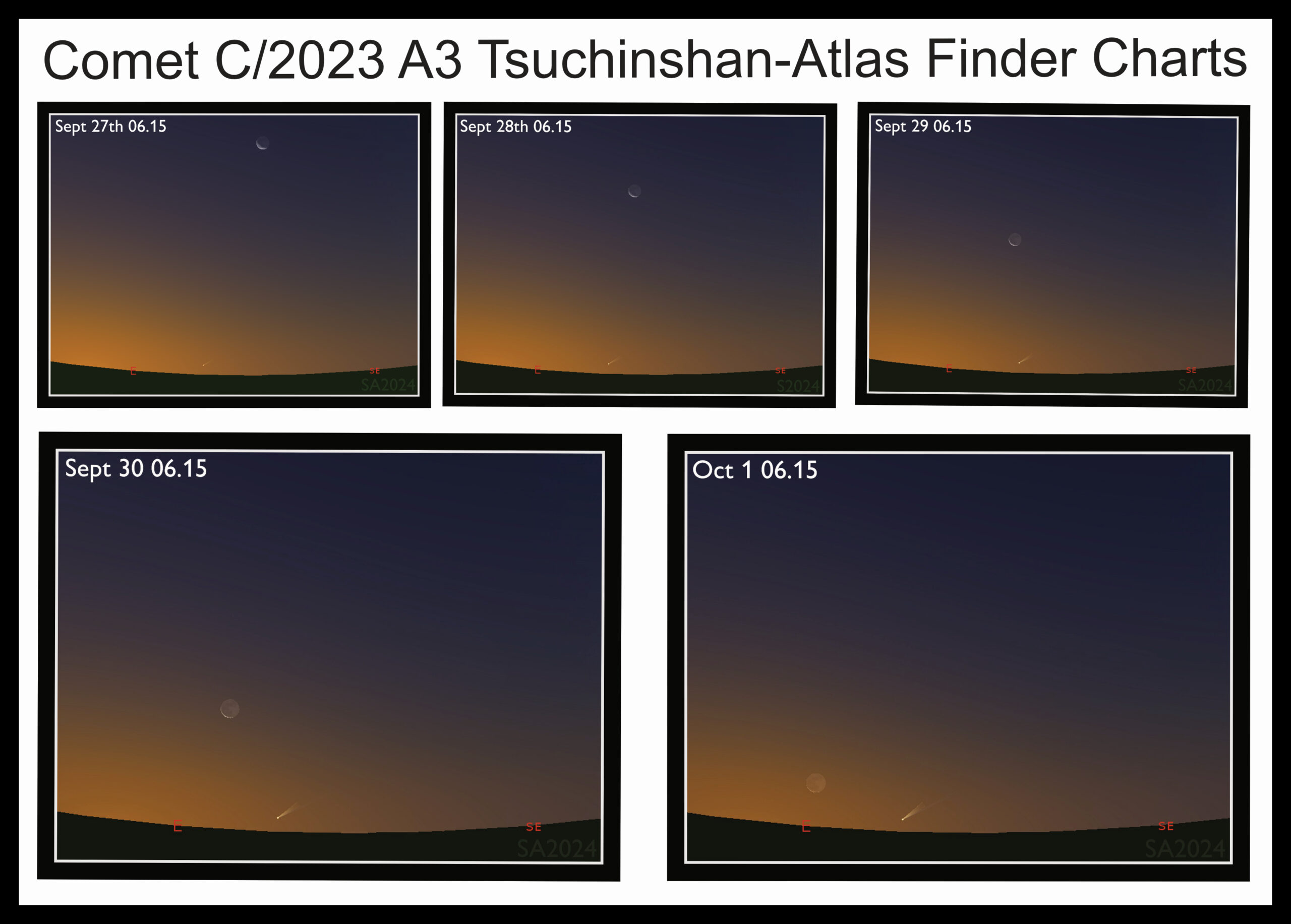
If you don’t see the comet this week don’t worry; weather permitting, we will have much better views in mid-October when the comet moves up into the darker evening sky. Here are some very basic finder charts for then, but please bear in mind that these are just very simple charts designed to point you in the right direction. They’re not predictions of either the tail’s length or its appearance in the sky.
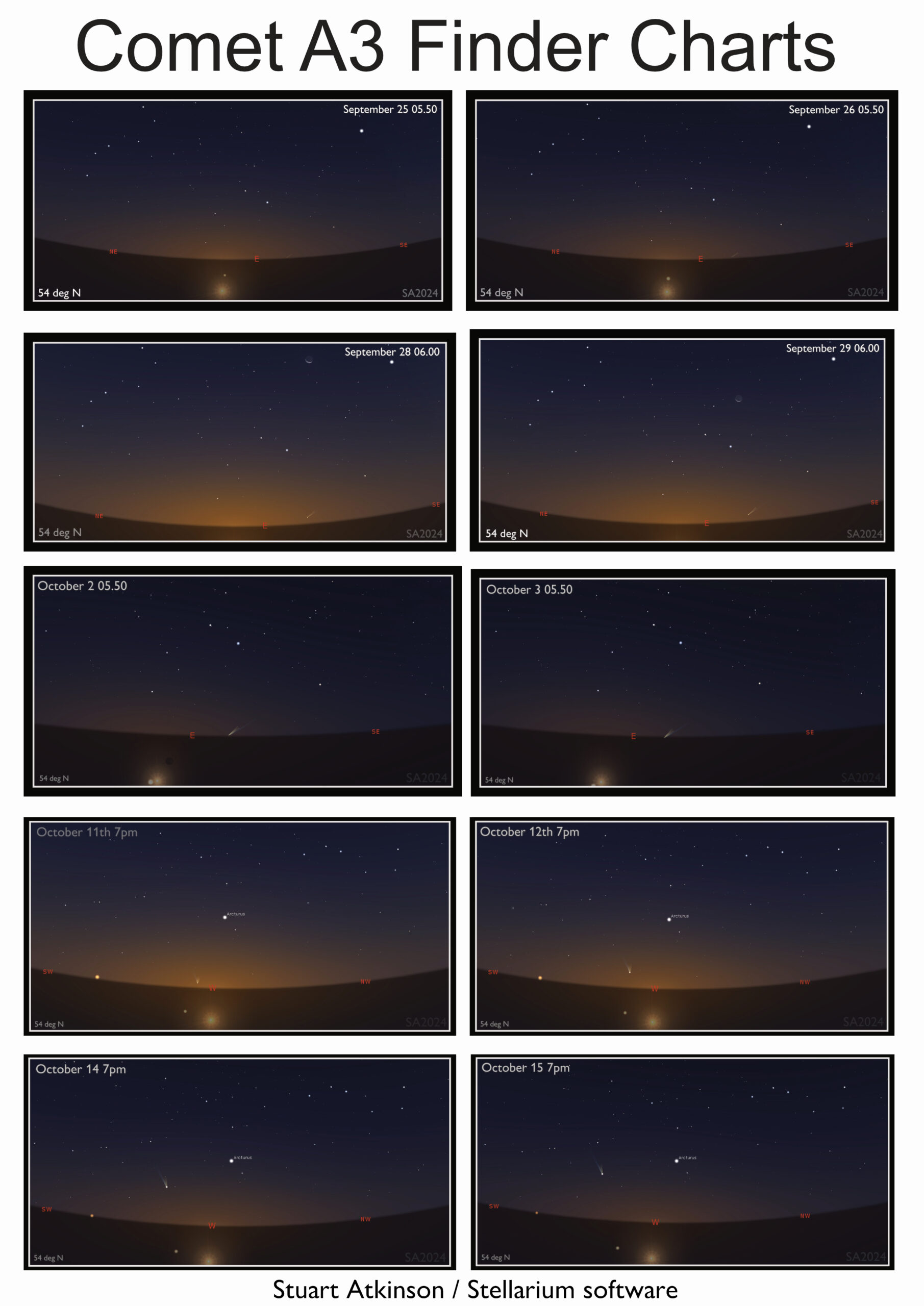
What will it actually LOOK like then?
If it becomes as bright as the latest calculations suggest, at its best Comet A3 will look like either a short section of an airplane contrail, perhaps as long as a pencil held at arm’s length, or it will look like a misty shuttlecock, greyish-white in colour. Unlike the AI-generated images of comets being used to illustrate sensational social media stories, its head will not look like a glitter ball from Strictly Come Dancing, and its tail will not be as long as a WW2 anti-aircraft searchlight…
And by the way, if you’re expecting to see the comet streak across the sky like a bright shooting star, trailing smoke and flame. it won’t. Comets don’t do that. A comet can take days, weeks or even months to cross the sky, depending on how close it comes to us. So you won’t see Comet A3 crossing the sky like the space station, or an airplane; you’ll only notice it has moved in relation to the stars around it if you follow it over several hours or on subsequent evenings.
As for how bright the comet will be at its best in mid-October, the honest answer is – we just don’t know! All we can say is that based on how it looks now, shining in the southern sky, Comet A3 should be bright enough to see clearly with the naked eye when it moves up into the northern sky. We know that our best views will come in mid-October, when it will be shining to the lower left of the curved handle of the Big Dipper in the evening twilight. What we don’t know is how bright it will be or how long its tail will be. We’ll just have to wait and see.
But the waiting is almost over. The comet isn’t coming anymore, it’s here. And although it might not be the Comet of The Century it was hyped up to be at the beginning, it looks like it might be the best comet for a long time.
Now, we just need the weather to co-operate…