
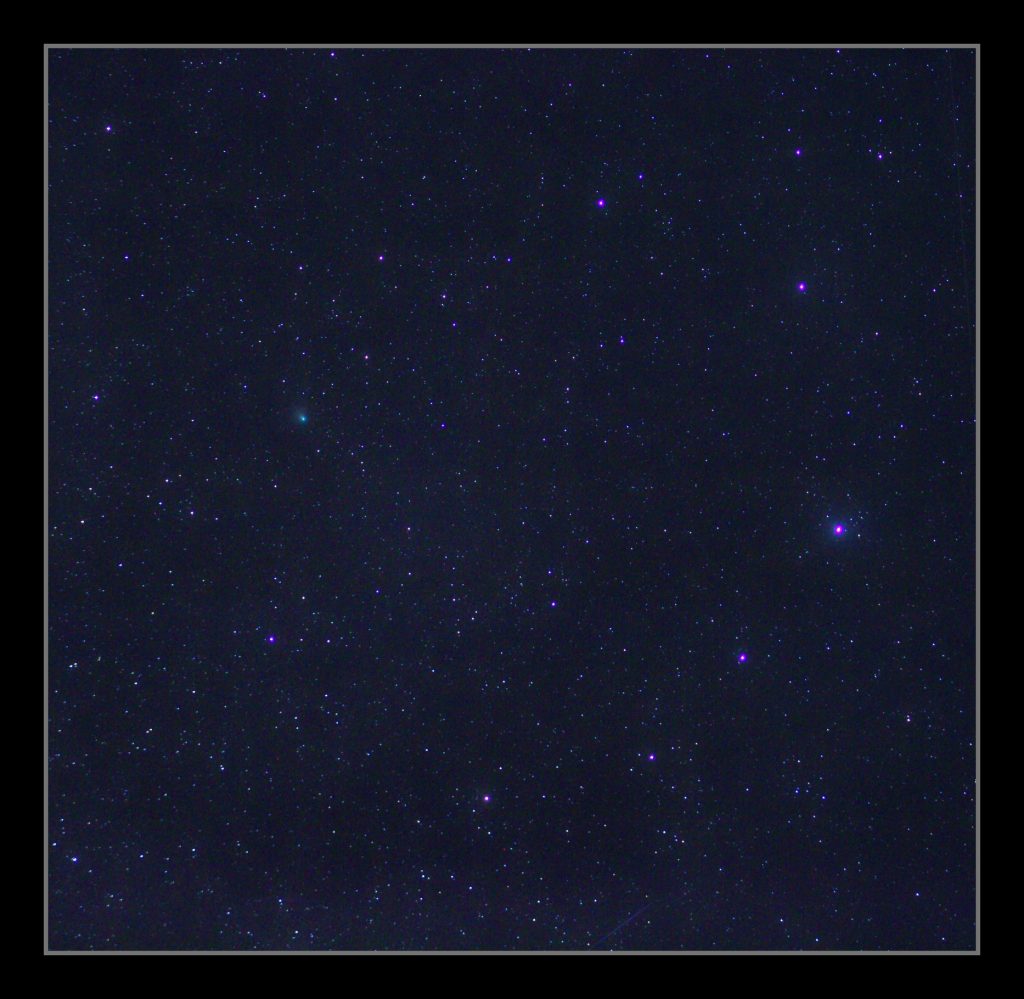
There is a comet in the sky that might – MIGHT – become bright enough to see with the naked eye in a few weeks’ time. Comet C/2022 E3 ZTF is already bright enough to be visible through binoculars and small telescopes, and long exposure photos show it has developed a very pretty, straight ion tail and a stubbier yellow-grey fan-shaped dust tail, but it is still very small, and many observers have yet to see it because of its diminutive size and because it is a morning object, visible in the hours before sunrise.The image at the top of the page was taken by myself on the morning of January 2nd, and is a crop from a processed stack of photos taken with an 80mm lens tracking the sky. You can see the comet to the upper left of the stars of Corona Borealis.
It also hasn’t helped that the weather over many parts of the UK has been horrible recently. Over the “festive period” bands of rain swept over much of the UK one after another, and when it wasn’t raining it was cloudy, so comet observers were left very frustrated. The bad weather shows no signs of abating for a while, but when the downpours stop and the clouds part – and they must do eventually! – E3 will definitely be worth looking for.
Comet C/2022 E3 ZTF (which I’ll just refer to as “E3” from now on) is a long period comet that was discovered by the Zwicky Transient Facility (hence the name “ZTF”) on 2 March 2022, using the 1.2-m, f/2.4 Schmidt telescope at Mount Palomar. When it was discovered it was just a tiny, 17th magnitude smudge in Aquila, still five times further from the Sun than Earth, but when astronomers crunched the numbers to calculate E3’s orbit and future track they found that the comet would reach perihelion – its closest point to the Sun – on 2023 Jan 12, and would then make a close approach to the Earth in early 2023 February, when it might reach 6th magnitude or brighter, if it behaved itself and didn’t sputter out like other comets have done.
At the start of December E3 was a very faint morning object in Corona Borealis, shining – if that’s the right word – at around magnitude 10. That low magnitude meant views of E3 were reserved for telescope owners, and even then it only looked like a very small, very faint smudge in an eyepiece, almost like a distant galaxy or globular cluster. As December progressed E3 began to grow more interesting. Long exposure photos taken from locations less cloudy than the UK, through telescopes and processed to bring out subtle structure, detail and colour, showed a short but obvious ion tail stretching out from the head of the comet, looking like a faint grey-blue scratch or vapour trail. The comet’s head was like an out of focus green star, with a yellow-grey fan shaped dust tail on one side of it. These images were encouraging to see because they showed E3 was following predictions about its activity and development. And as December drifted into January comet observers began to allow themselves to think that maybe, just maybe, E3 wasn’t going to let us down and might be visible to the naked eye as it passes Earth at month’s end.
So, where is this comet now?And where will it be when it is at its best?
At the moment, having been embedded in it for the past few months, E3 is just starting to climb up out of and away from the “bowl” of Corona Borealis. It is a morning object for observers at mid-northern latitudes, best seen between 3am and 6am, before the sky begins to brighten with the approach of sunrise. Soon the comet will really begin to move away from Corona, heading up towards the stars of the Big Dipper and, after that, Polaris, which it will pass quite close to on Jan 29th/30th. By then the comet will be visible in both the morning and the evening sky, giving observers (hopefully!) lots of opportunities to see and photograph it. The comet will be moving quickly at that point, so quickly in fact that its motion might well be visible through binoculars – not as a bright star whooshing through the field of view, but as a smudge moving slowly past background stars over the course of several minutes.
There are two obvious questions, of course. What will E3 look like at its best, and how bright will it be?
Well, remember lovely Comet NEOWISE that delighted us a couple of years ago? Remember its long, graceful, curved tail and bright head? E3 is going to look nothing like that, sorry, and it will look absolutely nothing like the illustrations being used in reports about the comet on social media. Chances are that any tail it develops will be a lot shorter and less obvious than NEOWISE’s, but it might surprise us. It will probably look more like a smudge in the sky, drifting past Polaris and the stars of Ursa Minor. But don’t dismiss that – it could be a very nice sight in binoculars and small telescopes.
As for how bright it will get, well, it’s never a good idea predicting in advance how bright a comet is going to be. Comets that have looked very promising in the past have let us down badly, while others that didn’t seem to have much potential have been pleasant surprises. All we can do is look at the numbers, and see how closely E3 has followed the predictions of its brightness so far. When we do that we see that it has followed those predictions very closely, with no surprises or blips, and if that behaviour continues then E3 could reach magnitude 5 or so when it passes us at the end of January/early February. Technically that will make it a naked eye object (the eye can see magnitude 6 and brighter) but in reality it will probably only be a naked eye object for those who are under dark skies, away from light pollution, and everyone else will have to see it through binoculars. But it might yet surprise us, and undergo an outburst, increasing its brightness briefly, we’ll just have to cross our fingers and wait and see.
Please, PLEASE ignore social media posts predicting great things for this comet. There are already people claiming it will be “spectacular!”, that it will “light up the sky!” as it “hurtles past us!” and they are all rubbish, written by people with absolutely no knowledge of astronomy who are often just cutting and pasting the rubbish reports of others. E3 is not going to be spectacular. But it is still something to look forward to!
If you want to see E3 at the moment you’ll have to get up early, find somewhere with a clear view to the east, and scan the sky beneath the handle of the Big Dipper, looking for a very small smudge. But soon the comet will be visible in the evening sky too, and the charts below will show you the comet’s track up towards and past the stars of Ursa Major during the month ahead.
